Model registry
Maintain a governed inventory for AI models and use-case context with lifecycle state, ownership, risk posture, and supporting evidence.
- • Structured model records and intake depth
- • Lifecycle visibility
- • Model-to-use-case alignment
Features
Everything an AI governance program needs — from governed inventory and agentic oversight to runtime safety, compliance evidence, and third-party risk — sharing the same records, audit trail, and reporting layer.
Feature hub overview
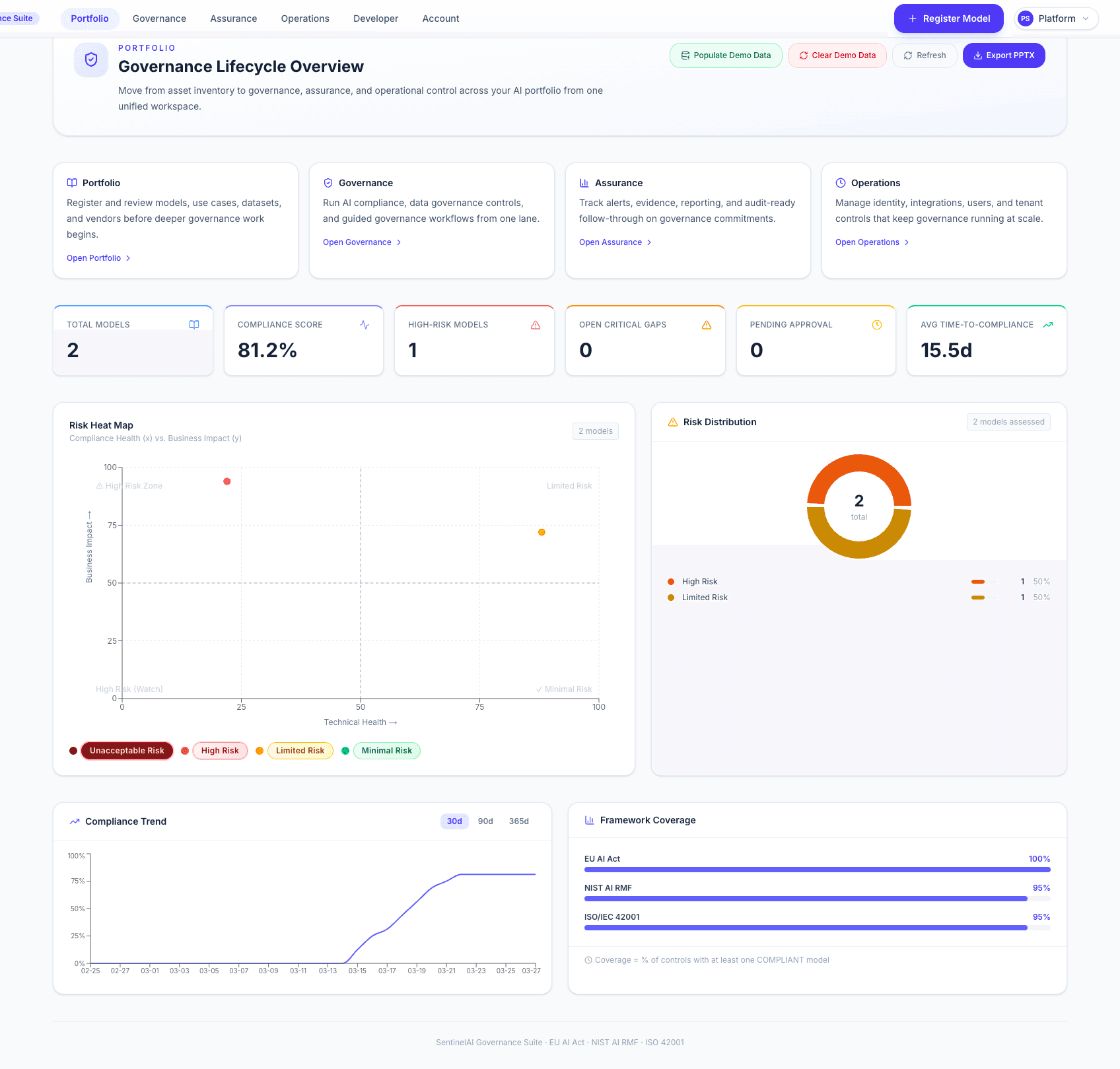
Every SentinelAI capability maps to one of four program goals: govern your AI inventory, monitor what it does in production, prove compliance with evidence, and manage the AI you procure rather than build. Because they share the same governed records and audit trail, work done in one area is instantly usable in the others.
Built for cross-functional teams
See it in action
The capabilities below aren't isolated modules. They share the same governed records, evidence trail, and reporting layer — so inventory, review, monitoring, and compliance stay in sync as your AI program grows.
Connects to the AI stack you already run
Govern & inventory
Register models, runtime systems, prompts, retrieval sources, datasets, and autonomous agents with ownership, lifecycle state, and connected governance context.
Monitor & safeguard
Track live output safety, telemetry, and evaluation signals — privacy-preserving by design — so governance keeps pace after release.
Comply & report
Map controls to frameworks, manage cases and releases, stay ahead of regulatory change, and export proof auditors can trust.
Third-party & supply chain
Run vendor due diligence, score contracts for risk, surface shadow AI, and document supply-chain provenance with an AI Bill of Materials.
Adjacent governance areas
These adjacent areas help buyers move from dedicated feature pages into framework positioning, trust content, and rollout guidance without duplicating product-detail copy.
Related capability
Position AI governance work against the EU AI Act, NIST AI RMF, and ISO 42001 without turning the feature hub into a framework microsite.
Related capability
Support enterprise oversight with role-based access control, MFA-aware workflows, and multi-tenant isolation.
Related capability
Use the docs layer and platform explainers to carry feature discovery into evaluation planning and rollout preparation.
Next step
Use this feature overview to orient stakeholders, then move into documentation, a demo, or a trial based on where your governance program is today.