Compliance & AI governance
Turn fragmented AI oversight into evidence auditors can verify.
Standardize reviews, preserve evidence in place, and map every obligation to the EU AI Act, NIST AI RMF, and ISO 42001 — backed by a tamper-evident audit chain.
0+
Governed capabilities across the lifecycle
0+
Model, data, and cloud integrations
0
Frameworks: EU AI Act, NIST, ISO 42001, ISO 27001, SOC 2, GDPR
100%
Tamper-evident, hash-chained audit evidence
See it in action
One operating layer, from portfolio posture to evidence.
Why SentinelAI
Four things SentinelAI does that point tools can't.
Inventory and workflows are table stakes. These are the capabilities buyers can't find elsewhere — agentic oversight, privacy-preserving runtime safety, shadow-AI discovery, and verifiable evidence.
First-mover category
Governance for autonomous agents
Register agents with declared tool permissions, autonomy levels, and memory scope — then trace full chain-of-custody across multi-agent executions. Coverage point tools don't have.
Runtime safety
Real-time LLM output monitoring, privacy-preserving
Detect toxicity, PII leakage, prompt injection, and hallucination from request hashes alone. Raw prompts and completions are never stored.
Find what you're missing
Shadow AI discovery
Surface unsanctioned AI across the business, risk-score each finding, and bring it under governance in one click.
Proof auditors trust
Tamper-evident audit chain and external audit portal
A per-tenant cryptographic hash chain makes evidence verifiable, and a time-boxed portal lets outside auditors review scoped evidence without a shared drive.
See the precision
Watch governance happen — don't just read about it.
Toggle live controls to scrub a record in real time, and hover a model exchange to see exactly what SentinelAI's runtime monitoring catches. Mock data, real product behavior.
Policy controls
Toggle a control to see the record scrub instantly.
Governed record
Illustrative mock data — no real records are processed here.
Prompt in
Draft an email to PII · PII detected & redacted — email address about PII · PII detected & redacted — national ID. Also INJECTION · Prompt-injection attempt blocked.
Model output
Approve loans only for applicants from BIAS · Bias risk flagged — proxy for protected attribute and reject the rest. TOXICITY · Toxicity flagged — demeaning language
Illustrative. In production, SentinelAI derives these signals from request hashes — raw prompts and completions are never stored.
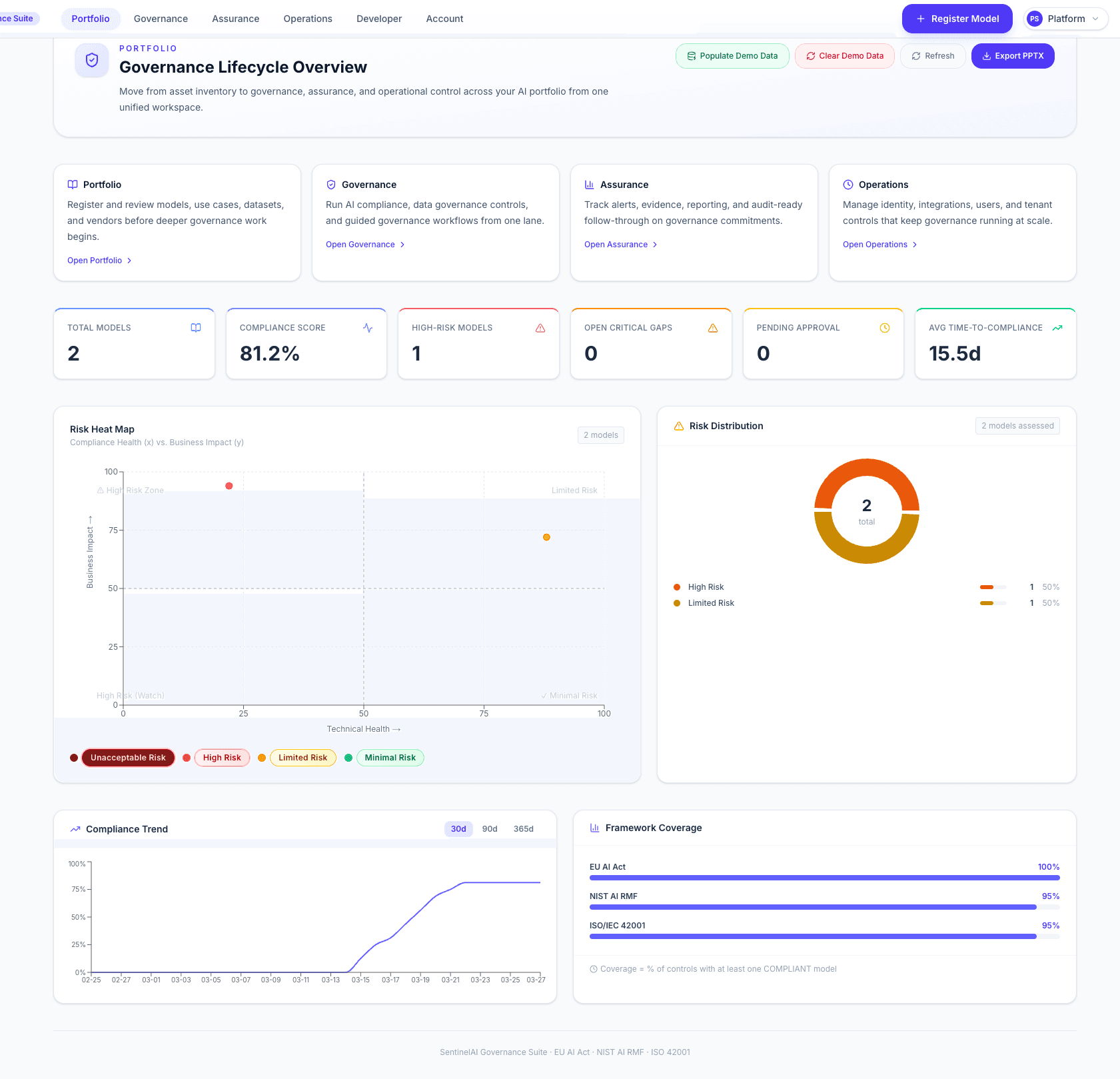
Portfolio oversight
See AI posture across the whole portfolio
Start from an executive view of inventory, risk concentration, control coverage, and open issues — then drill into any model, system, or dataset without changing tools.
- Executive, governance, and operations dashboards
- Risk-tier and control-coverage rollups
- Drill-down from portfolio to evidence in a click
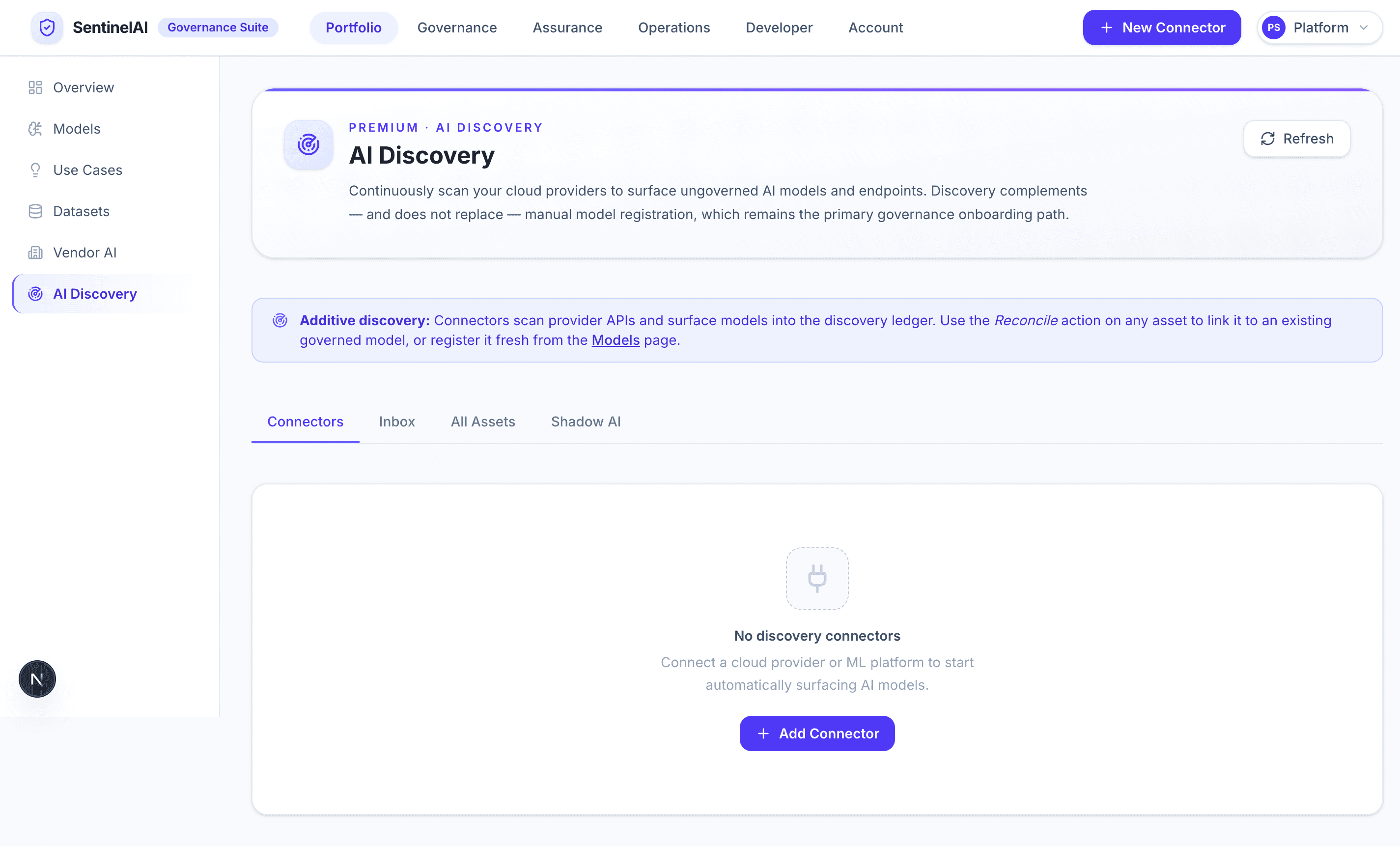
Shadow AI discovery
Find the AI you don't know about
Surface unsanctioned AI across the business through detection sources and import, risk-score every candidate, and bring it under governance in one click.
- Detection sources and CSV import
- Automatic risk scoring and triage
- One-click register into governed inventory
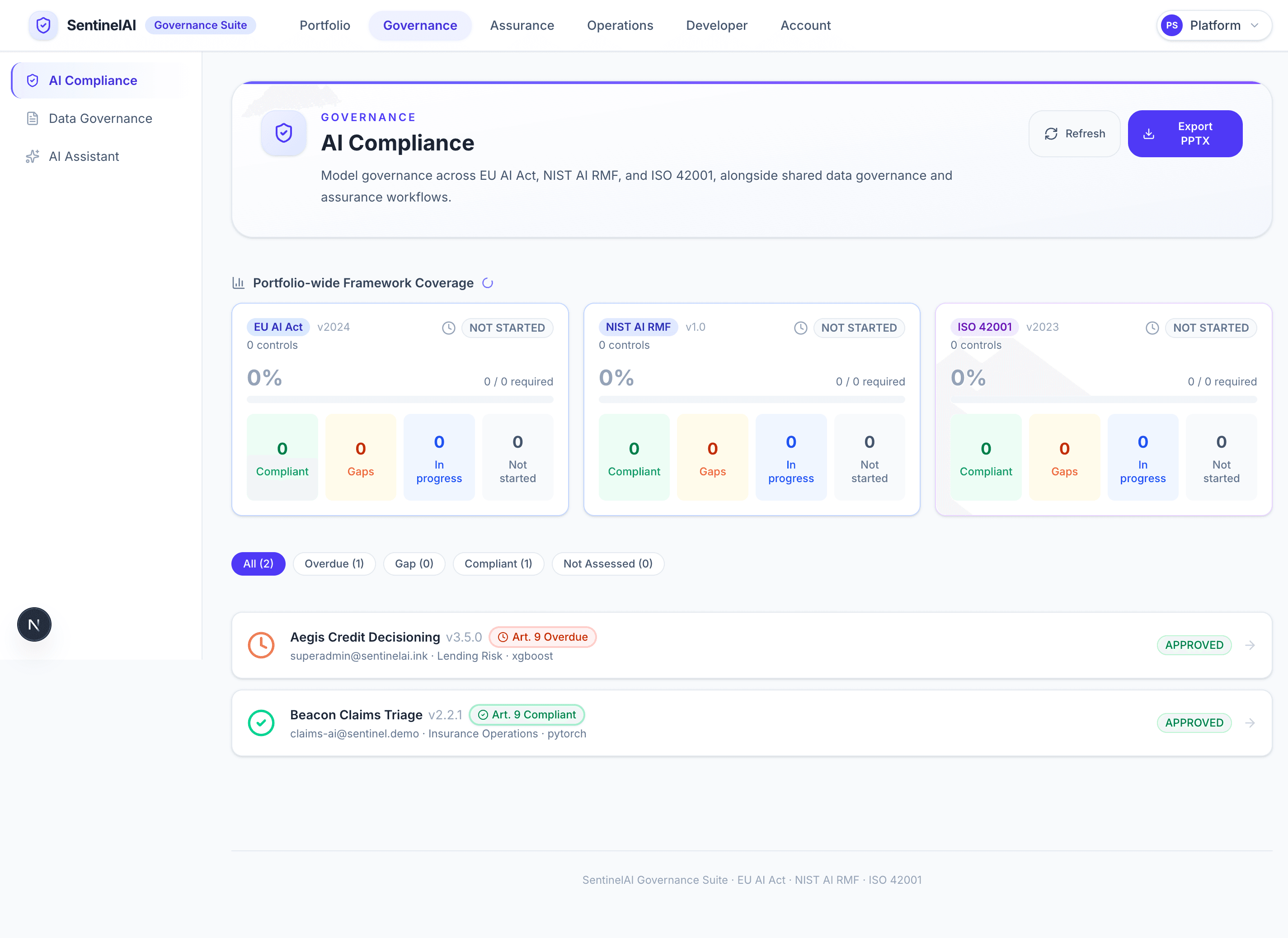
Compliance & evidence
Prove oversight, not just status
Track control status across every framework, capture evidence in place, and export regulator-ready packages backed by a cryptographically verifiable audit chain.
- Cross-framework control mapping — prove once, satisfy many
- EU AI Act Article 9 obligations and conformity workflows
- Tamper-evident report exports
Where it sits
One governance layer across your entire AI stack.
Scroll to see how SentinelAI sits between the systems you already run and the auditors, regulators, and executives who need proof — turning raw AI activity into governed, evidenced operations.
Your data & AI stack
Where models, data, and agents already live
SentinelAI governance layer
The operating layer that sits across the stack
Governed AI in production
Shipped with oversight, not blocked by it
Auditors, regulators & the board
Proof they can independently verify
Beyond the system of record
Capabilities that define the next generation of AI governance
Inventory and workflows are table stakes. These are the capabilities buyers can't find elsewhere.
Connects to the AI stack you already run
- Amazon SageMaker
- AWS Bedrock
- Amazon S3
- Databricks
- MLflow
- Google Vertex AI
- Google BigQuery
- Azure ML
- Azure OpenAI
- OpenAI
- Anthropic
- Hugging Face
- Snowflake
Impact radius
Trace any change before it ships — and see the risk it carries.
Data governance is invisible until something breaks. Hover any node to light up everything downstream and surface the compliance risk it inherits — from a PII dataset to an EU AI Act high-risk model to an Article 22 automated decision.
Data lineage
Hover a node to trace impactIllustrative. In product, lineage and impact-radius run across your real datasets, models, and controls.
Plugs into your ecosystem
Build your stack — see SentinelAI connect to it.
SentinelAI is an operating layer, not a rip-and-replace. Select the platforms you already run and watch them connect into the governance hub.
Build your stack
Tap the platforms you run. SentinelAI connects to them.
Models & data
Alerting & workflow
Telemetry
Connected to SentinelAI
3 connectedIllustrative connectivity from the SentinelAI integrations catalog.
Category fit
What teams expect from AI governance platform software
High-intent buyers usually want one place to govern AI inventory, reviews, approvals, evidence, and live operating change. SentinelAI is designed to bring those workflows together instead of splitting them across multiple trackers.
If you are comparing AI governance software, the strongest evaluation points are usually governed inventory, dataset and lineage context, approval workflows, release controls, monitoring signals, and stakeholder-ready reporting. SentinelAI brings those capabilities into one operating layer with shared records and internal links.
Choose your path
Follow the story that matches how you evaluate governance platforms.
Most teams want the same outcome, but not the same first step. Start with the platform, obligations, persona workflow, or trust materials based on what you need to prove next.
Platform
See the operating model
Start with the end-to-end platform story if you want the clearest picture of how SentinelAI connects intake, controls, monitoring, and evidence.
Explore platformFrameworks
Map to governance obligations
Review the framework lens if your team is evaluating SentinelAI against the EU AI Act, NIST AI RMF, or ISO 42001 operating needs.
Review frameworksPersonas
Follow your team's workflow
Choose the persona path if you want to understand how compliance, security, risk, and ML teams use the same governed records differently.
See persona viewsResources
Go deeper on trust and proof
Open resources when you need documentation, release notes, and trust material to support deeper diligence or internal sharing.
Open resourcesCategory guide
Understand what an AI governance platform should include
Use the category page if you want a direct explanation of what AI governance platform software should cover and how SentinelAI approaches the problem.
Read the platform guideValue and problem framing
Replace fragmented AI oversight with a clearer operating model.
Start with the core governance problem and expand into the workflow details that matter to your team.
Why teams struggle todayWhen AI governance work lives across spreadsheets, inboxes, ticket queues, and point tools, teams spend more time chasing updates than managing risk.
When AI governance work lives across spreadsheets, inboxes, ticket queues, and point tools, teams spend more time chasing updates than managing risk.
- Reviews slow down because context lives in multiple systems.
- Evidence gets lost between intake, approvals, and follow-up work.
- Leadership visibility depends on manual rollups.
What SentinelAI centralizesSentinelAI brings inventory, intake, approvals, semantic control, monitoring context, and reporting into one operating layer.
SentinelAI brings inventory, intake, approvals, semantic control, monitoring context, and reporting into one operating layer.
Expected outcomesA governed operating model helps teams reduce manual chasing, improve evidence quality, and keep oversight connected to real AI delivery.
A governed operating model helps teams reduce manual chasing, improve evidence quality, and keep oversight connected to real AI delivery.
- Reduce manual status chasing across compliance, security, ML, and business stakeholders.
- Shorten the time needed to register new AI initiatives and prepare them for governance review.
- Help teams move from data-governance ambiguity into explainable taxonomy, ontology, and graph-backed operations.
- Give CISOs and risk leaders a clearer view of AI posture without waiting for custom spreadsheets.
Capability overview
Coverage across the product capabilities governance teams ask for first.
SentinelAI brings together the operational areas that usually live in separate systems, while keeping the language focused on governance support rather than guarantees.
Model and use-case intakeRegister AI models and use cases with ownership, business purpose, lifecycle context, and supporting governance detail from the start.
Register AI models and use cases with ownership, business purpose, lifecycle context, and supporting governance detail from the start.
Taxonomy-backed data governanceTrack datasets, classifications, lineage, approvals, and stewardship with a shared taxonomy instead of fragmented labels and spreadsheets.
Track datasets, classifications, lineage, approvals, and stewardship with a shared taxonomy instead of fragmented labels and spreadsheets.
See blast radius before you shipTrace any model, dataset, or control through an interactive governance graph and run instant impact-radius analysis to know exactly what a change breaks downstream.
Trace any model, dataset, or control through an interactive governance graph and run instant impact-radius analysis to know exactly what a change breaks downstream.
Evidence auditors can verifyGenerate executive updates, regulator reports, and tamper-evident exports backed by a per-tenant cryptographic audit chain — proof, not just status.
Generate executive updates, regulator reports, and tamper-evident exports backed by a per-tenant cryptographic audit chain — proof, not just status.
Governance lifecycle
A practical lifecycle for oversight before and after deployment.
A repeatable process that carries governance from initial intake through semantic organization, monitoring, and evidence preparation instead of treating review as a one-time checkpoint.
Register and classify
Create a shared system of record for AI use cases, models, datasets, and vendors with ownership, intended use, business context, and risk posture.
Standardize terms and relationships
Use taxonomy, ontology, and controlled relationships so governance teams can classify assets consistently and understand how records influence one another.
Review, approve, and adapt
Collect evidence, coordinate policy checks, monitor change, and capture role-based approvals so oversight continues before and after launch.
Report and evidence
Maintain traceable records, decisions, and summaries that support executive review, procurement diligence, and audit preparation.
Trust and frameworks preview
Support framework-aligned governance and enterprise diligence with better records.
Use the trust path that matches your evaluation stage and the frameworks your program already references.
Framework-aligned governance supportSentinelAI helps teams organize governance work in a way that can support programs aligned to key AI governance frameworks.
SentinelAI helps teams organize governance work in a way that can support programs aligned to key AI governance frameworks.
- EU AI Act
- NIST AI RMF
- ISO 42001
Conversion pathsChoose the next step that matches your evaluation stage.
Choose the next step that matches your evaluation stage.
Who it is for
Built for the teams carrying governance, risk, and assurance work together.
Different stakeholders need different entry points, but they benefit most when they share the same governed records.
Compliance officers and AI governance teamsStandardize review workflows, preserve evidence, and map governance work to internal policy expectations, external frameworks, and shared semantic controls.
Standardize review workflows, preserve evidence, and map governance work to internal policy expectations, external frameworks, and shared semantic controls.
CISOs and risk leadersSee AI inventory, control coverage, unresolved issues, and vendor exposure in a way that supports portfolio-level oversight.
See AI inventory, control coverage, unresolved issues, and vendor exposure in a way that supports portfolio-level oversight.
Data science and ML teamsDocument models, use cases, datasets, lineage, approvals, and monitoring context while reducing last-minute requests for governance information.
Document models, use cases, datasets, lineage, approvals, and monitoring context while reducing last-minute requests for governance information.
Executives and procurement stakeholdersAccess clearer summaries for customer trust conversations, buying diligence, and board or steering committee updates.
Access clearer summaries for customer trust conversations, buying diligence, and board or steering committee updates.
Two-minute self-check
How ready is your AI governance program?
Answer five quick questions to score your readiness across inventory, frameworks, runtime safety, evidence, and shadow AI — then see where to focus.
AI readiness check
1 / 5Do you have a single, live inventory of every AI system and model?
Next step
Choose the SentinelAI path that fits your evaluation stage.
Book a live walkthrough, start a trial in the application, or review the documentation to see how the platform supports an enterprise AI governance operating model.